Birthstones & Birth Month Flowers
It’s my birthday, so today I’m posting some birthday correspondences – gems, flowers, colors. You can also check out our information about the astrological signs. These can be used as taglocks or correspondences in spells, or to tap into seasonal energies. The cool thing about the flower correspondences, for example, is that they all bloom in their corresponding months. Isn’t that cool?
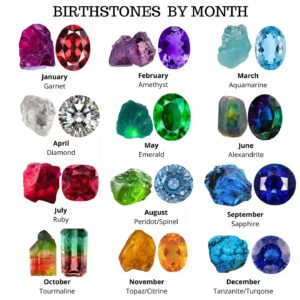
Birth Stones
The traditions of birthstones and birth month flowers have deep and varied origins, with different cultures and beliefs contributing to their meaning over thousands of years. They are not based on any scientific research but are a beautiful and symbolic way to mark a person’s birth. I’m based in the United States, and I grew up with the following traditions. In 1912, the National Association of Jewelers (now Jewelers of America) in the United States standardized the list of “modern” birthstones, making them more marketable and widely accepted. This list has been updated a few times since to include new stones.
| MODERN | TRADITIONAL | |
| JAN | Garnet | Garnet |
| FEB | Amethyst | Amethyst |
| MAR | Aquamarine | Bloodstone |
| APR | Diamond | Diamond |
| MAY | Emerald | Emerald |
| JUN | Alexandrite | Pearl |
| JUL | Ruby | Ruby |
| AUG | Peridot, Spinel | Sardonyx |
| SEP | Sapphire | Sapphire |
| OCT | Tourmaline | Opal |
| NOV | Golden Topaz Citrine | Topaz |
| DEC | Blue Zircon Blue Topaz Tanzanite | Turquoise Lapis Lazuli |
For centuries, people would collect all 12 stones and wear one each month, believing it gave them heightened powers during that specific time. The modern tradition of wearing only the stone for one’s birth month didn’t become popular until the 16th century, originating in Germany or Poland. Wouldn’t that be something to bring back to your modern practices? Wear each month’s “birthstone” to gain the attributes of that month. I used to carry stones like this when I was studying and learning their energies. Perhaps you want to carry a Tiger’s Eye stone in your pocket, or on a piece of jewelry for all of November. What effect do you think that might have?
Birth Flowers
| PRIMARY | SECONDARY | |
| JAN | Carnation | Snowdrop |
| FEB | Violet | Primrose |
| MAR | Daffodil | Jonquil |
| APR | Daisy | Sweetpea |
| MAY | Lily of the Valley | Hawthorn |
| JUN | Rose | Honeysuckle |
| JUL | Larkspur | Water Lily |
| AUG | Gladiolus | Poppy |
| SEP | Aster | Morning Glory |
| OCT | Marigold | Cosmos |
| NOV | Chrysanthemum | |
| DEC | Narcissus | Holly |
The tradition of birth month flowers is believed to date back to ancient Roman times, a period when birthday celebrations first began. Romans used flowers to decorate altars for their gods and gave them as gifts, and it’s thought they were among the first to assign symbolic meanings to different flowers.
The practice gained popularity and a more structured meaning during the Victorian era. The Victorians developed a complex “language of flowers” or floriography, where different flowers and even the way they were arranged could convey a secret message or emotion. Giving a specific flower for a specific month became a way to communicate a wish or a trait associated with that month.
Many of the chosen birth flowers are tied to the season in which they bloom and carry a meaning associated with that time of year or with cultural and religious stories. For example, daffodils represent new beginnings and rebirth, fitting for their March bloom.
In essence, these traditions are a blend of ancient beliefs, cultural practices, religious symbolism, and, in modern times, a bit of commercial standardization. They are a way to give a personal and meaningful gift that is steeped in history and folklore.